
Swarovski 25-60x65mm Spotting Scope Review
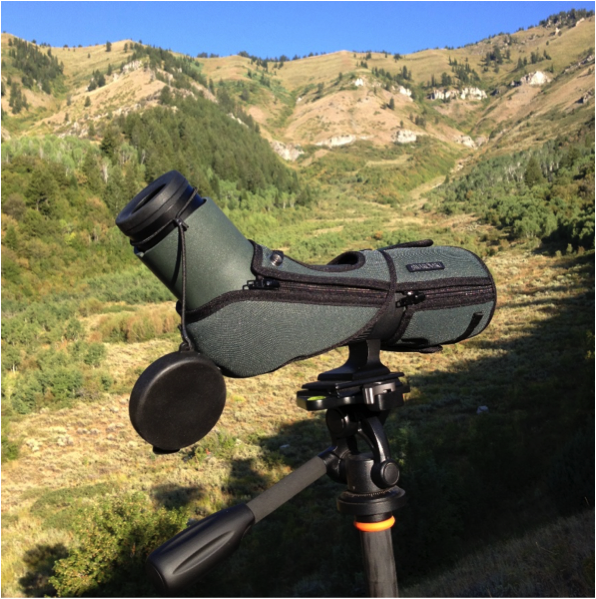
If you’re a serious big game hunter, then you know that a quality spotting scope is one of your most important tools. The phrase ‘let your eyes do the walking’ doesn’t mean you’re a lazy hunter, it means you’re a smart hunter. Sometimes we are confined by unit regulations to only harvest certain types of animals, be it unbranched bull elk in a spike only unit, full curl Dall Sheep (the ‘full curl’ requirement can actually be met in a few different ways, all of which a quality scope helps in determining!), a nanny-only mountain goat hunt, and the list goes on and on. Or maybe you just want to find the biggest, oldest buck that you can, but there’s hundreds of square miles to cover from your glassing spot where he could be hiding. If you can’t accurately make out what it is exactly that you’re looking at through your binos, or with your naked eye, then you’re stuck in between a rock and a hard spot not knowing if what you’re looking at is worth your time and energy to go after. This is where a quality spotting scope can really help you out. Now the word quality in terms of a spotting scope will mean different things to different people; some can’t or won’t spend as much on a scope as others, some people only like certain types or designs, and for some, size and weight play a big influence on their decision of what scope to get. But in the end, I think a quality spotting scope means that you are seeing as far as possible with the clearest possible image and maximum possible light transmission. In my opinion, the Swarovski ATX 25-60 x 65 mm spotting scope is the definition of a quality scope.
The ATX 65 mm scope for me is the perfect blend of multiple elements: size taken up in and weight added to your pack, sleek ergonomics, and unrivaled optical clarity. I chose the ATX model over the STX model simply because I like an angled spotting scope. Since I do a lot of backpacking, a scope that doesn’t take up half the space in my pack, or add too much extra weight, is something I really put a lot of importance on. The ATX 65 mm is listed as weighing 55.9 ounces, or 3.49 pounds. That small weight penalty is something I’ll gladly take so that I can see how big a buck is that I’ve glassed up across the canyon over a mile away. And at just over 13 inches long, it doesn’t take up much room at all in my pack.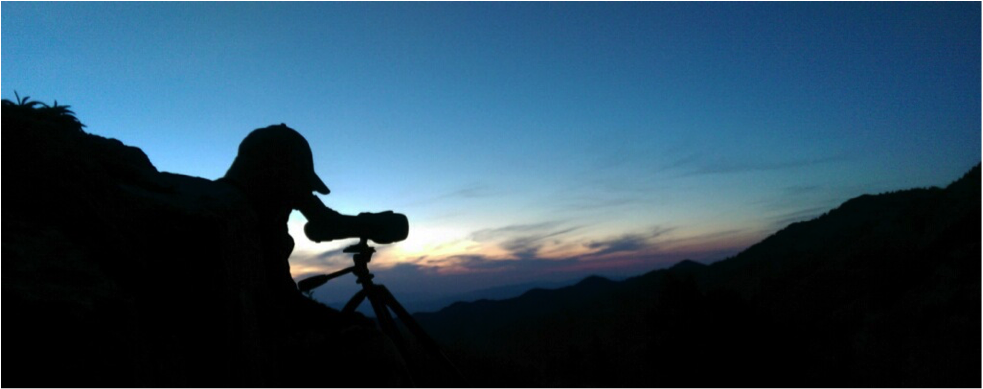 When you're 4+ miles back in like I was in this photo, every ounce counts
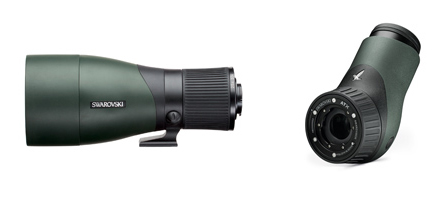 I really like how I can keep my eye on what I’m looking at and with one hand, or really even just two fingers, I can zoom in or out as well as fine tune the focus. The zoom knob is slightly stiffer than the focus knob, but not by much, and the focus knob slides around as smooth as silk. An extremely smooth focus knob is really important to me because sometimes all it takes is a fraction of a centimeter worth of adjusting to bring that buck into focus when he’s well over a mile away. The scopes rubber armor coating is incredibly durable and I actually like how it feels to the touch. I have had no issues with the rubber coating whatsoever. I also purchased the Swarovski ATX stay-on case for the eyepiece and objective lens, and while sometimes it seems unnecessary, I like that it adds another layer of protection from abrasion and the elements.
While scouting mule deer in the high country a couple years ago with two friends, we got to perform an in-field scope comparison within the first hours of light on a late-July morning. We all had different scopes, so it was fun to swap back and forth to see the differences in optical performance. Tyler had the Swarovski ATS 80 HD and James had a Vortex Viper. After each having about 10-15 minutes glassing for bucks with each of the three scopes we had between us, we all agreed that the two Swarovski scopes blew the Viper out of the water; there wasn’t any competition there in any of our eyes. But what I thought was interesting was the distinction we seemed to observe between the two Swarovski scopes. James and I both thought that the light transmission was roughly the same between the two, (James gave a slight edge to my ATX 65 over the ATS 80), but we both agreed that the clarity of the ATX 65 was slightly better than that of the ATS 80. Tyler, who owned the ATS 80, said he honestly couldn’t tell a noticeable difference between either model in terms of image clarity, but he did say the ATX seemed to be a tad brighter depending on the position and color of the object he was looking at. What I took from this comparison on the mountain that morning confirmed to me that the Swarovski ATX is the best glass out there hands down, and that with the ATX model Swarovski has improved upon the previous ATS design and made an even more impressive scope.
One feature that I have come to love about my ATX is that I can unscrew the rubber eyecup, and with the help of a step-up adapter that mates to my digital camera, I can digiscope with this setup and obtain some stunning images with very minimal hardware. One thing I really like about the digital camera I use (an Olympus TG-3) is that it has an optical zoom and no lens that extends as you zoom. This enables me to use the step-up adapter to get the camera lens right next to the scope lens, and since the camera is screwed on to the adapter, I never worry about bumping it and having it fall off.
I really like how I can keep my eye on what I’m looking at and with one hand, or really even just two fingers, I can zoom in or out as well as fine tune the focus. The zoom knob is slightly stiffer than the focus knob, but not by much, and the focus knob slides around as smooth as silk. An extremely smooth focus knob is really important to me because sometimes all it takes is a fraction of a centimeter worth of adjusting to bring that buck into focus when he’s well over a mile away. The scopes rubber armor coating is incredibly durable and I actually like how it feels to the touch. I have had no issues with the rubber coating whatsoever. I also purchased the Swarovski ATX stay-on case for the eyepiece and objective lens, and while sometimes it seems unnecessary, I like that it adds another layer of protection from abrasion and the elements.
While scouting mule deer in the high country a couple years ago with two friends, we got to perform an in-field scope comparison within the first hours of light on a late-July morning. We all had different scopes, so it was fun to swap back and forth to see the differences in optical performance. Tyler had the Swarovski ATS 80 HD and James had a Vortex Viper. After each having about 10-15 minutes glassing for bucks with each of the three scopes we had between us, we all agreed that the two Swarovski scopes blew the Viper out of the water; there wasn’t any competition there in any of our eyes. But what I thought was interesting was the distinction we seemed to observe between the two Swarovski scopes. James and I both thought that the light transmission was roughly the same between the two, (James gave a slight edge to my ATX 65 over the ATS 80), but we both agreed that the clarity of the ATX 65 was slightly better than that of the ATS 80. Tyler, who owned the ATS 80, said he honestly couldn’t tell a noticeable difference between either model in terms of image clarity, but he did say the ATX seemed to be a tad brighter depending on the position and color of the object he was looking at. What I took from this comparison on the mountain that morning confirmed to me that the Swarovski ATX is the best glass out there hands down, and that with the ATX model Swarovski has improved upon the previous ATS design and made an even more impressive scope.
One feature that I have come to love about my ATX is that I can unscrew the rubber eyecup, and with the help of a step-up adapter that mates to my digital camera, I can digiscope with this setup and obtain some stunning images with very minimal hardware. One thing I really like about the digital camera I use (an Olympus TG-3) is that it has an optical zoom and no lens that extends as you zoom. This enables me to use the step-up adapter to get the camera lens right next to the scope lens, and since the camera is screwed on to the adapter, I never worry about bumping it and having it fall off.
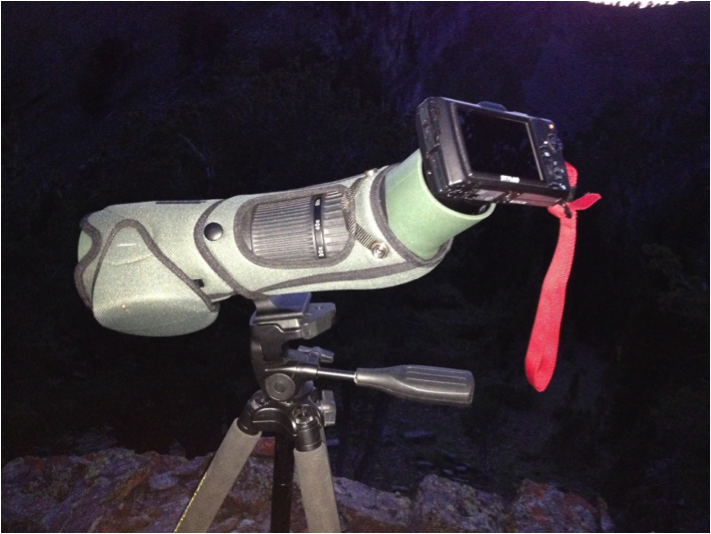 If you do decide to do something like this with your ATX, don’t be alarmed if when you unscrew the eyecup you find a white greasy substance in the threads. The first time I did this I was worried that something had somehow worked its way under the eyecup and embedded itself in the threading. I started to attempt to clean it out, but then thought better of it and decided to contact Swarovski about it. It turns out that it was a grease applied to the eyecup threads in the factory to keep them lubed and smooth and that it should be there. I’m glad I contacted them first!
Now, your spotting scope is partially at the mercy of the tripod you put it on and how steadily the tripod supports the scope. If you’re going to invest in the ATX 65 mm, or any spotting scope for that matter, do yourself a favor and get a good tripod with a good sturdy head. Every tripod has its own niche: some are more suited for backcountry packing trips where size and weight are a concern, some are better for standing and glassing wildlife on the winter range, and some are better for photography purposes. A lot of tripods span multiple categories, but whichever one you get, make sure it’s ideal for the majority of situations you plan to use your scope in.
I personally feel that the Swarovski ATX 65 mm is the best scope out there, and that Swarovski glass is at the pinnacle of optical performance. I have never once regretted the money I spent on my scope, and I have never been tempted to sell or upgrade it. I see it as an investment that has helped save my legs countless miles of hiking because I have always been able to tell if an animal is worth going after or not by looking at it from miles away, and that will allow me to keep going in the mountains for longer than I would be able to otherwise if I had to hike over to everything I saw to evaluate it. You will not regret buying the Swarovski ATX 65 mm spotting scope. Buy once, cry once and then rest easy knowing you’ve got the best spotter money can buy!
If you do decide to do something like this with your ATX, don’t be alarmed if when you unscrew the eyecup you find a white greasy substance in the threads. The first time I did this I was worried that something had somehow worked its way under the eyecup and embedded itself in the threading. I started to attempt to clean it out, but then thought better of it and decided to contact Swarovski about it. It turns out that it was a grease applied to the eyecup threads in the factory to keep them lubed and smooth and that it should be there. I’m glad I contacted them first!
Now, your spotting scope is partially at the mercy of the tripod you put it on and how steadily the tripod supports the scope. If you’re going to invest in the ATX 65 mm, or any spotting scope for that matter, do yourself a favor and get a good tripod with a good sturdy head. Every tripod has its own niche: some are more suited for backcountry packing trips where size and weight are a concern, some are better for standing and glassing wildlife on the winter range, and some are better for photography purposes. A lot of tripods span multiple categories, but whichever one you get, make sure it’s ideal for the majority of situations you plan to use your scope in.
I personally feel that the Swarovski ATX 65 mm is the best scope out there, and that Swarovski glass is at the pinnacle of optical performance. I have never once regretted the money I spent on my scope, and I have never been tempted to sell or upgrade it. I see it as an investment that has helped save my legs countless miles of hiking because I have always been able to tell if an animal is worth going after or not by looking at it from miles away, and that will allow me to keep going in the mountains for longer than I would be able to otherwise if I had to hike over to everything I saw to evaluate it. You will not regret buying the Swarovski ATX 65 mm spotting scope. Buy once, cry once and then rest easy knowing you’ve got the best spotter money can buy!
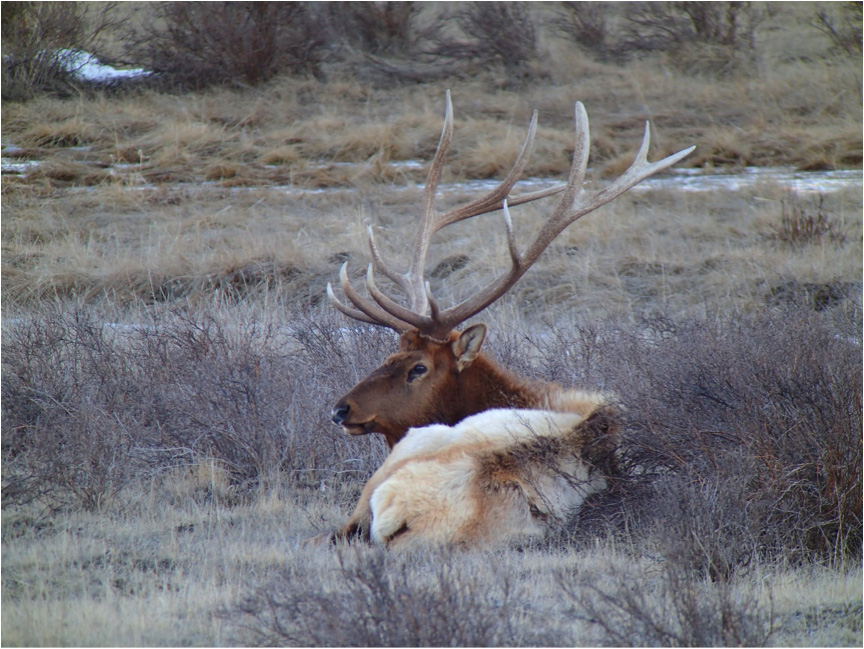
A bull I digiscoped. He was over 1/4 mile away in this picture.
3 Comments